
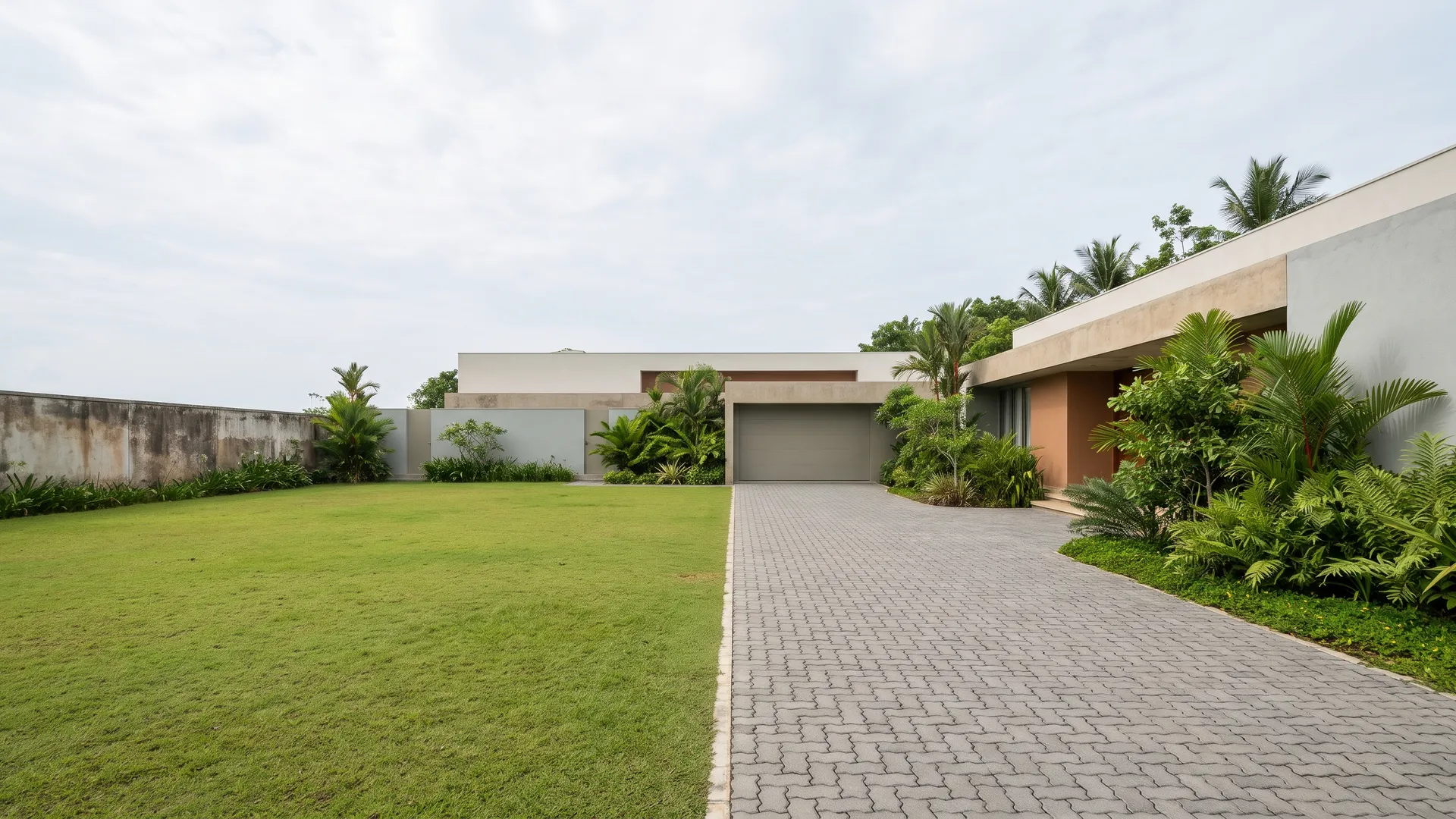
What are interlock pavers?
Interlock pavers are individual paving blocks shaped to lock together, like pieces of a jigsaw. Unlike a poured concrete slab, each block can be lifted out and laid again. That gives a surface that drains better, cracks less, and can be opened to reach pipes or cables underneath without breaking up the whole area.
How do interlock pavers compare with poured concrete?
The main differences are speed, repairs and what happens to the surface at the end of its life.
| Interlock pavers | Poured concrete | |
|---|---|---|
| Ready to use | Immediately after installation | After the concrete has cured |
| Installation in stages | Laid in sections; finished areas can be used straight away | The slab is poured and cured as a whole |
| Weather | Work can continue in conditions that would delay concrete work | More easily delayed by weather |
| Equipment | Less heavy machinery | More heavy machinery |
| Repairs | Damaged blocks are replaced without affecting the rest | Repairs disturb the surrounding surface |
| Reuse | Blocks can be removed, moved and laid again | Cannot be lifted and reused |
| Drainage | Rainwater seeps through | Drains less well |
| Cracking | Less prone to cracking | More prone to cracking |
What are the benefits of interlock pavers?
- Reusable. Pavers can be removed, relocated and reused without damage, which reduces construction waste.
- Permeable. Rainwater seeps through the surface. That reduces runoff, helps prevent flooding, filters the water naturally and supports groundwater recharge.
- Cooler. Lighter colors and the permeable design help reduce the urban heat island effect.
- Long-lasting. A longer lifespan means fewer replacements and a lower environmental impact.
- Fast to lay. Installation is quick, with minimal curing time compared with poured concrete.
What designs are available?
Interlock pavers come in modern and classic styles, so they suit both contemporary and traditional buildings.
- Modern patterns: geometric designs with clean lines.
- Classic patterns: herringbone, basketweave and running bond.
- Colors: from neutral earth tones to vibrant hues.
- Textures: smooth, tumbled or textured surfaces.
- Sizes: various dimensions for different spaces and visual effects.
Where are interlock pavers used?
- Driveways and parking areas: they carry vehicle weight.
- Patios and outdoor living spaces: areas for relaxation and entertainment.
- Garden paths and walkways.
- Pool decks: the surface is slip-resistant and stays cool underfoot. See our guide to pool surround pavers.
- Retaining walls: structural elements that also work as design features.
For lawns you can drive on, see our guide to grass pavers.
How are interlock pavers installed?
A driveway or path is built in layers: compacted ground, a compacted base, a thin bed of sand, then the pavers. Most paving that sinks or spreads later was let down by the layers underneath, not by the blocks.
- Excavate. Dig out soft soil, roots and rubble to the depth of the base, the sand and the paver, and shape the ground so water will run off.
- Lay and compact the base. Spread the base material in layers and compact each one. A driveway needs a deeper base than a footpath, because it carries vehicles.
- Fit edge restraints. They contain the pavers, prevent shifting and keep the pattern intact.
- Spread the bedding sand. Level a thin, even layer of sand over the base. It is not there to fill hollows in the base.
- Lay the pavers. Work outwards from a straight edge in the chosen laying pattern, and cut blocks to fit at the edges.
- Compact the surface. Running a compactor over the pavers beds them into the sand and levels the surface.
- Fill the joints. High-quality polymeric sand locks the pavers in place and prevents weed growth.
If someone else is laying your paving, our questions to ask a paving contractor cover each of these steps. For what the groundwork does to the price, see driveway cost.
How do you maintain interlock pavers?
Sweep and wash the surface periodically, and re-sand the joints when needed. That keeps the pavers looking good and working properly.
Frequently asked questions
Can interlock pavers be reused?
Yes. Interlock pavers are individual units, so they can be lifted, moved and laid again without damage. That reduces construction waste.
How soon can you use interlock pavers after installation?
Immediately. Unlike poured concrete, interlock pavers have no curing time, and a finished section can be used while the rest is still being laid.
Do interlock pavers help with drainage?
Yes. Rainwater seeps through the paved surface instead of running off it, which reduces runoff, helps prevent flooding and supports groundwater recharge.
How are driveway pavers installed?
In layers. The ground is excavated and compacted, a base is laid and compacted, edge restraints are fitted, a thin bed of sand is levelled, the pavers are laid and compacted, and the joints are filled with sand.
What stops interlock pavers from shifting?
Edge restraints contain the paved area and hold the pattern, and polymeric joint sand locks the pavers in place. The sand also prevents weed growth.
Interlock pavers from Eco Bricks & Tiles
We supply interlock pavers across Sri Lanka. Contact us for a product catalog and samples, a design consultation for your project, professional installation, and maintenance guidance and support.
Browse our paving blocks range or request a free consultation.
Related guides
- Paving blocks: which design for a veranda, path or garage
- Pavers in Sri Lanka: types, uses and maintenance
- Interlock bricks in Sri Lanka (for building walls)
- Grass pavers in Sri Lanka
- Hiring a paving contractor: 10 questions to ask first
- Paver laying patterns: herringbone, stretcher, basket weave
- Moss, algae and weeds on pavers: cleaning after the monsoon